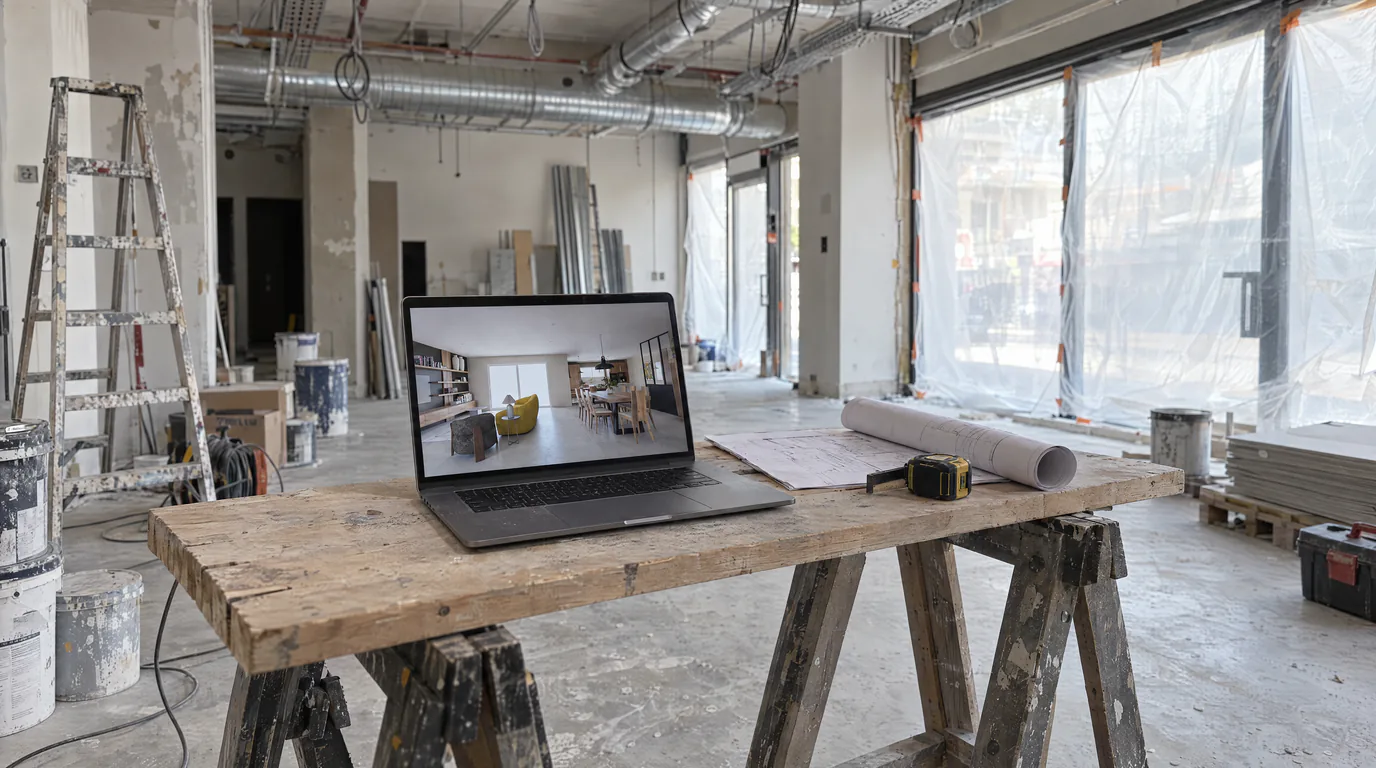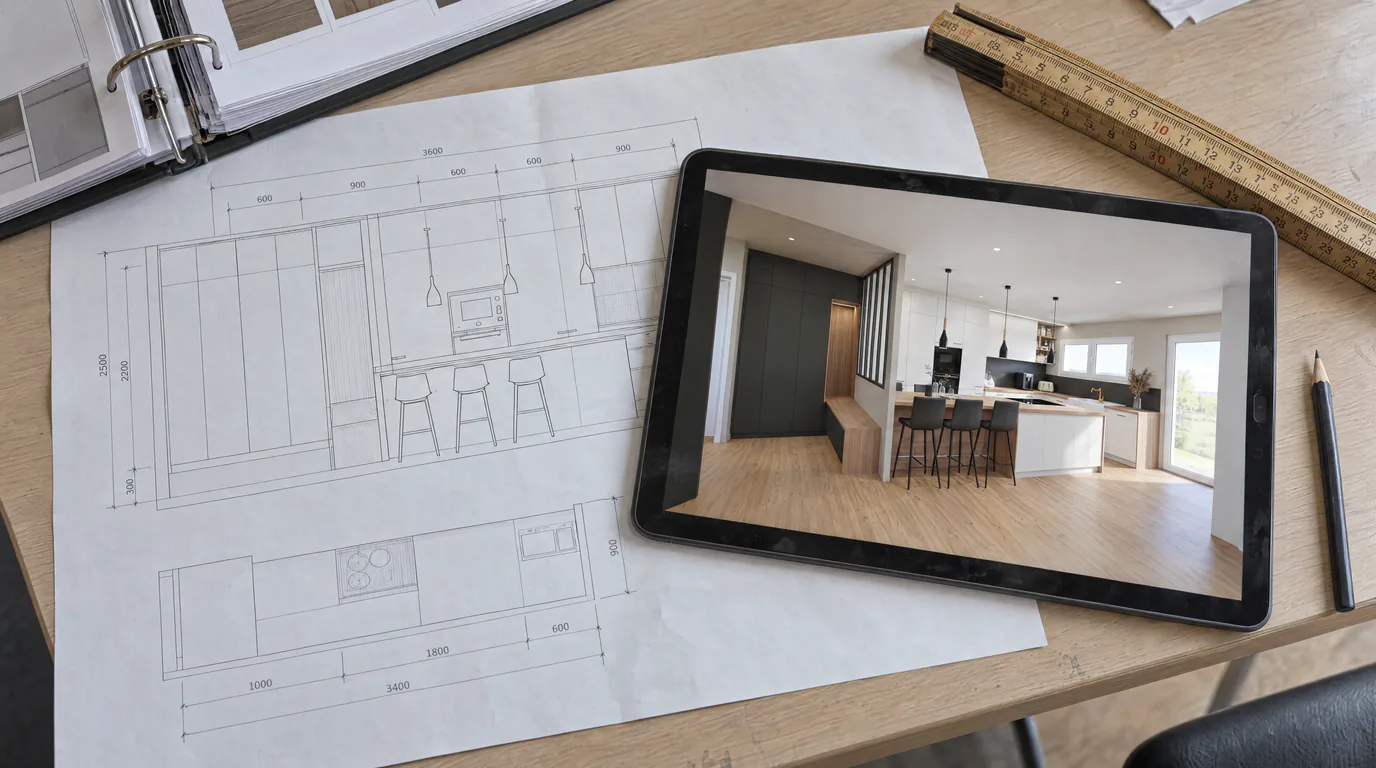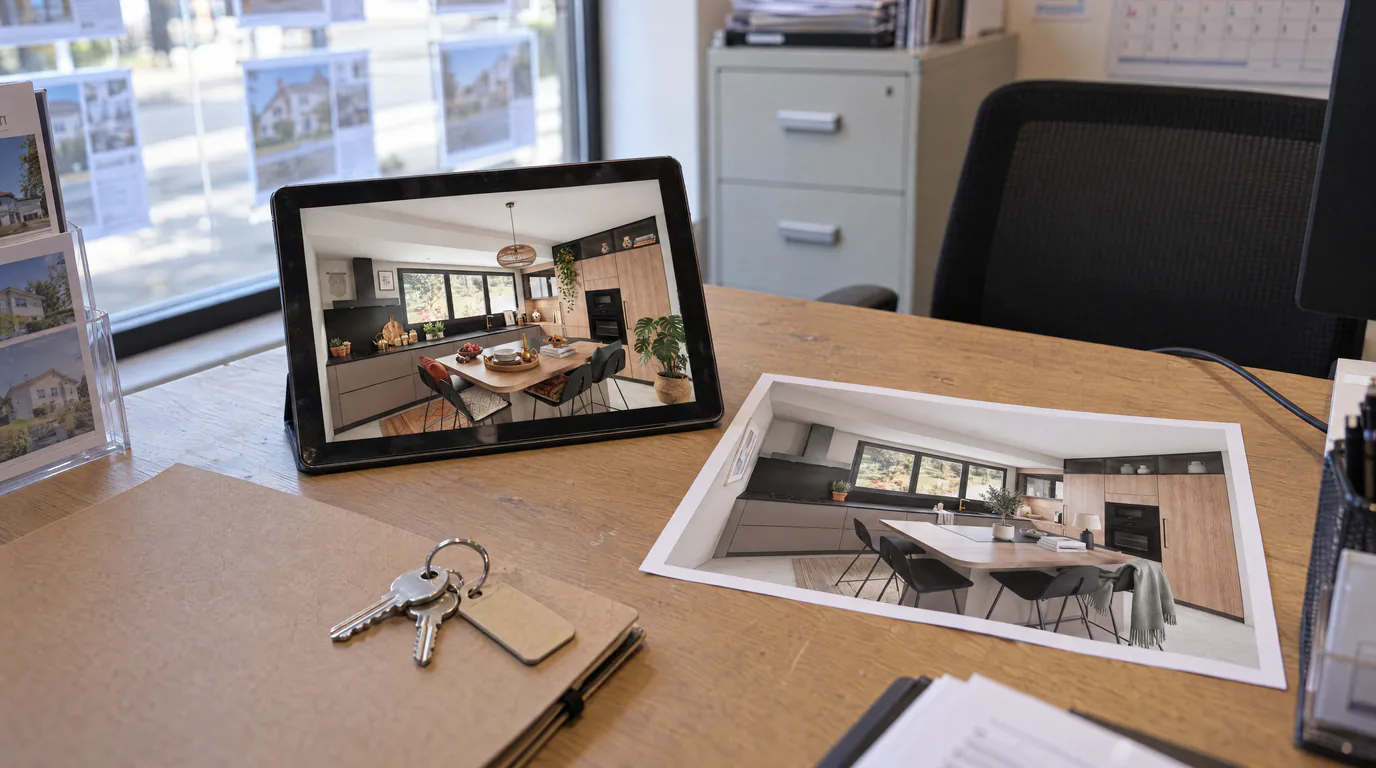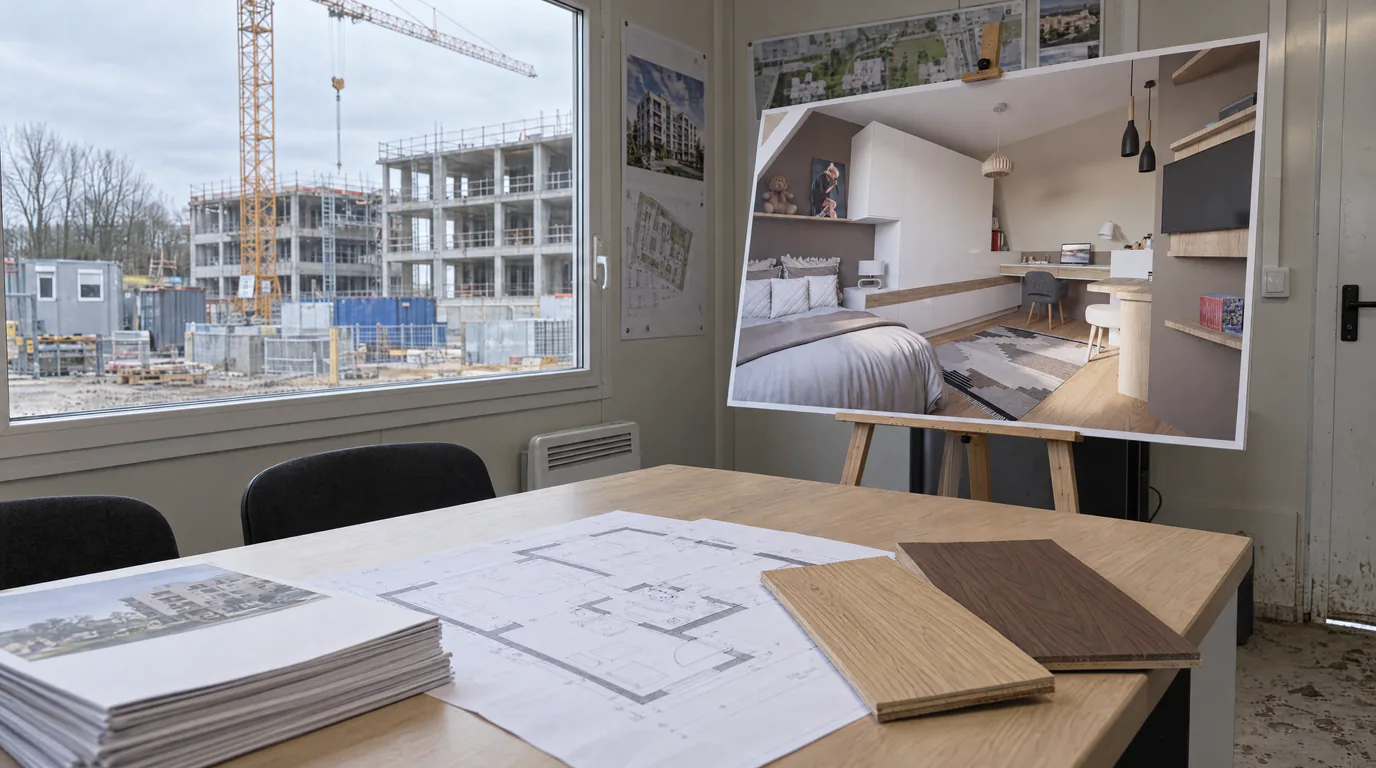
Selling an apartment that does not exist yet is a formidable challenge. The real estate developer must convince buyers to sign a reservation agreement for a property they cannot visit, touch, or live in for 18 to 24 months. In this context, the quality of visuals is not a detail, it is the cornerstone of commercialization. AI-powered photorealistic rendering is radically transforming this equation by making visual production faster, more flexible, and considerably less expensive.
Off-plan sales: why photorealistic renders are essential
When selling off-plan, the buyer purchases based on a floor plan, a specifications document, and, if the developer invests, a handful of 3D visuals. The problem is that most buyers cannot read a floor plan. They struggle to imagine what a 35 m² living room with 2.6 m ceilings, a southwest orientation, and floor-to-ceiling bay windows will actually look like.
This is why photorealistic renders have become essential to commercialization. A buyer who sees a render of their future living room, complete with natural lighting, finishes, and furniture, is far more likely to sign than one who only has a technical plan and a sales brochure in front of them.
The traditional rendering process: expensive and rigid
Historically, developers hire 3D visualization agencies to produce their marketing visuals. The process is well-established but cumbersome:
Brief and plan delivery: the developer provides the architectural plans, finish specifications, and detail sheets to the agency.
Modeling and rendering: the agency models each space, applies materials, sets up lighting, and produces the renders. Typical timeline: 2 to 4 weeks.
Validation rounds: the developer requests changes (camera angle, material, brightness), with each correction taking several days.
Cost: between €500 and €2,000 per visual depending on complexity and detail level. For a development of 50 units with 5 typologies, the rendering bill can reach €10,000 to €30,000.
This model works, but it is slow, rigid, and costly. Most importantly, it does not allow quick responses to marketing needs. If a buyer wants to see an alternative finish, or if market conditions require repositioning the offer, every change means an amendment, a delay, and an additional cost.
AI rendering for developers: speed, flexibility, and scale
With AI-powered rendering, the developer or their architect can produce photorealistic visuals in minutes instead of weeks. The process is straightforward:
1. The architect exports views from their design software (SketchUp, AutoCAD, Revit, ArchiCAD, Blender, 3ds Max) in PNG, JPEG, or WebP format.
2. The images are uploaded to the platform. In under 2 minutes per image, the AI generates a photorealistic render that respects the geometry, proportions, and materials of the project.
3. The renders are immediately available for integration into sales brochures, the development website, or marketing materials.
The gain is threefold. In terms of time: from 2-4 weeks down to a few hours for a complete development. In terms of cost: a few credits per render instead of €500 to €2,000 per visual. In terms of flexibility: every modification is instant, with no amendment or delay.
AI editing and buyer customization packages
This is perhaps the most powerful application for developers. In most new-build developments, buyers can customize their finishes from several options offered by the developer: the buyer customization package.
Traditionally, these options are presented in a sample book or a brochure with color swatches. The buyer must imagine the result. With AI editing, you can show each option on a photorealistic render of the actual apartment.
Light oak flooring or dark walnut? White tile or marble-effect tile in the bathroom? Gray paint or white paint in the living room? Each variant is generated in under 2 minutes: you paint the surface to modify and the AI applies the new finish.
The result: buyers concretely visualize their choices instead of guessing. Hesitations decrease, costly late-stage modification requests during construction drop, and client satisfaction increases significantly.
Producing photorealistic renders at development scale
A typical real estate development features between 5 and 15 different apartment typologies (studio, 1-bed, 2-bed, 3-bed, duplex, penthouse). For each typology, you ideally need at least 2 to 3 renders (living room, kitchen, master bedroom). That represents 10 to 45 renders for a single development.
With a visualization agency, this volume represents a budget of €5,000 to €90,000 and a timeline of 4 to 8 weeks. With AI rendering, the same volume is produced in one to two working days, at a fraction of the cost.
This production capacity at scale opens possibilities that were previously unthinkable. You can produce renders for every individual unit, not just generic typologies. The buyer of unit B204 sees their exact apartment, with their view, their orientation, and their finishes. This level of personalization was economically impossible with the traditional model.
Marketing and presenting developments effectively
Renders are just one link in the marketing chain. The presentation builder lets you create sales packages per unit, combining renders of each room, floor plans, finish variants, and key development information. These packages are shareable via secure links, viewable on mobile, and constitute a far more powerful sales tool than a static PDF.
Team collaboration is also streamlined. Sales teams, architects, and marketing departments can all access renders and presentations, share credits, and work together on visual production.
The measurable impact on off-plan sales
Developers who integrate quality photorealistic renders into their marketing see measurable results:
Faster reservations: buyers who can visualize their future apartment make decisions more quickly. The reservation cycle shortens.
Fewer withdrawals: a buyer who has seen and validated photorealistic renders faces fewer surprises and has fewer reasons to pull out.
Stronger development positioning: professional-quality visuals position the development as premium, supporting sale prices.
Reduced marketing costs: in-house AI render production significantly reduces dependence on external service providers and associated costs.
Step into next-generation real estate marketing
Off-plan sales demand exceptional visuals. Your buyers deserve to see their future home before signing. AI makes this possible at a scale and cost that were unimaginable just a few years ago. Do not let your competitors take the lead.
Create your account and get 14 days free. Upload the exports from your next development and discover what AI rendering can bring to your commercialization. The first renders will be ready in minutes.