When we talk about photorealistic renders, the conversation usually revolves around visual quality. But for an interior design or fit-out professional, the real question lies elsewhere: how much revenue does it actually generate? The calculation is worth running, and it will probably surprise you.
Why most professionals underestimate the ROI of photorealistic renders
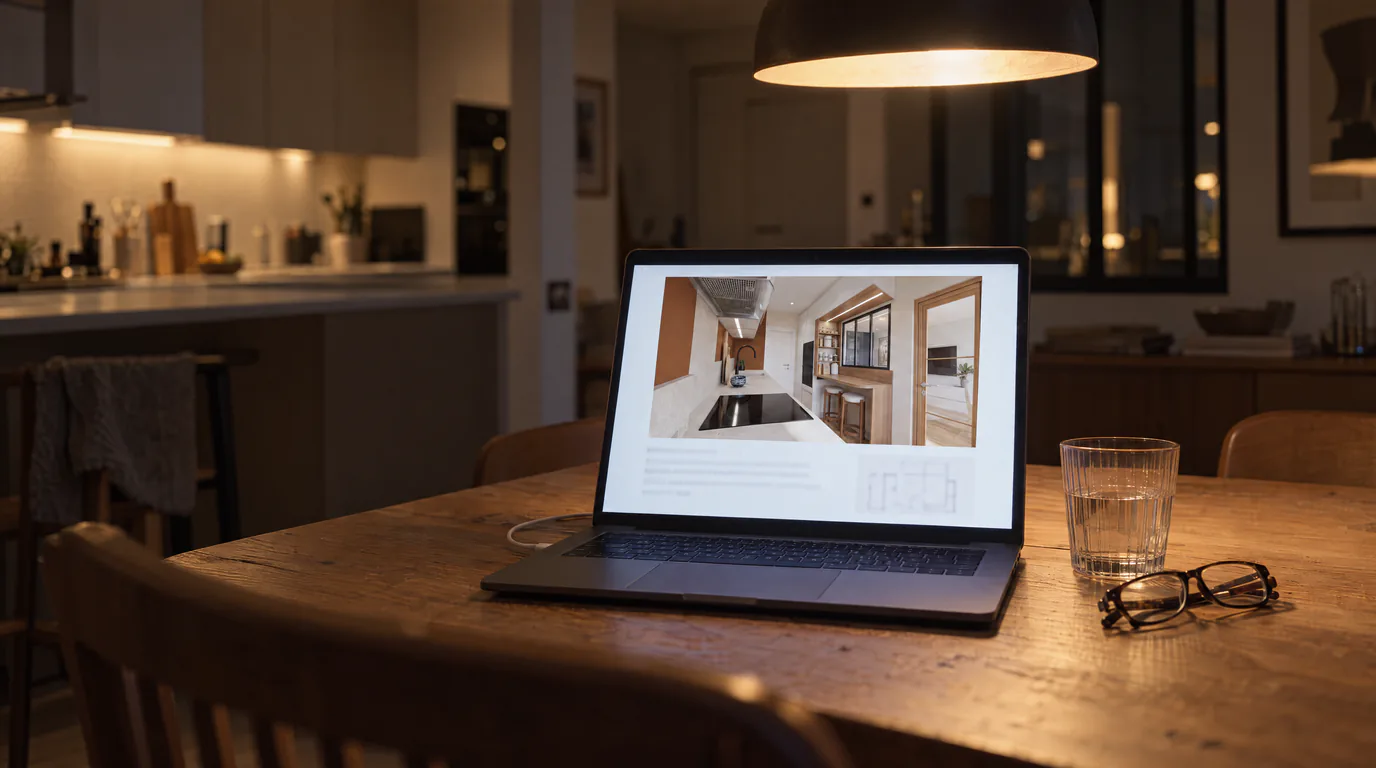
Most professionals know that a beautiful render helps sell. But few truly measure the gap between "helps a little" and "completely changes the game." Presenting photorealistic visuals rather than technical plans or basic renders changes the nature of the conversation with the client. For a design professional, it is often the difference between a hesitant prospect and a project that actually gets signed.
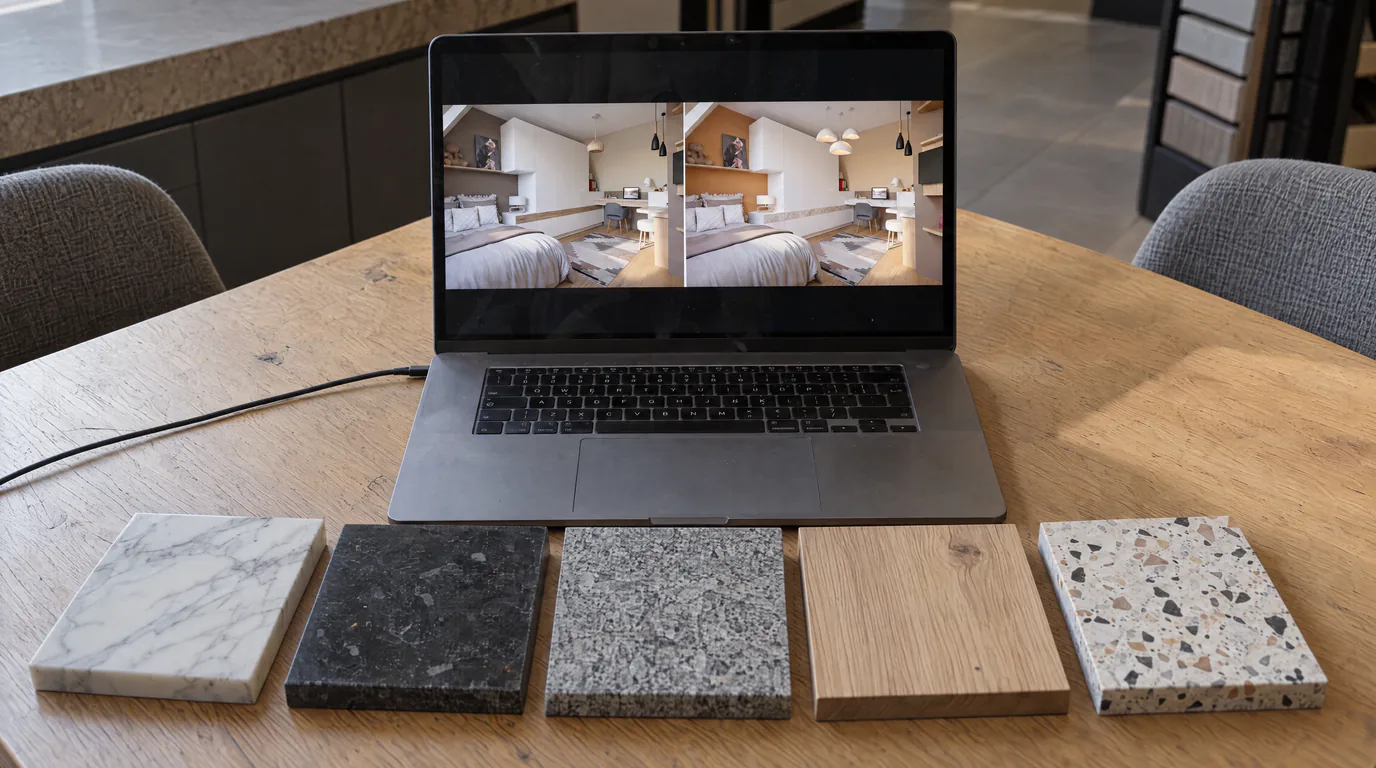
Why such a gap? Because your client is not a professional. They cannot read a floor plan. They cannot imagine what natural oak will look like next to a quartz countertop. But show them a photorealistic image where they see themselves in their future kitchen, and the decision becomes emotional. And emotional decisions are made quickly.
The economic equation: a render for a few cents, a project worth thousands
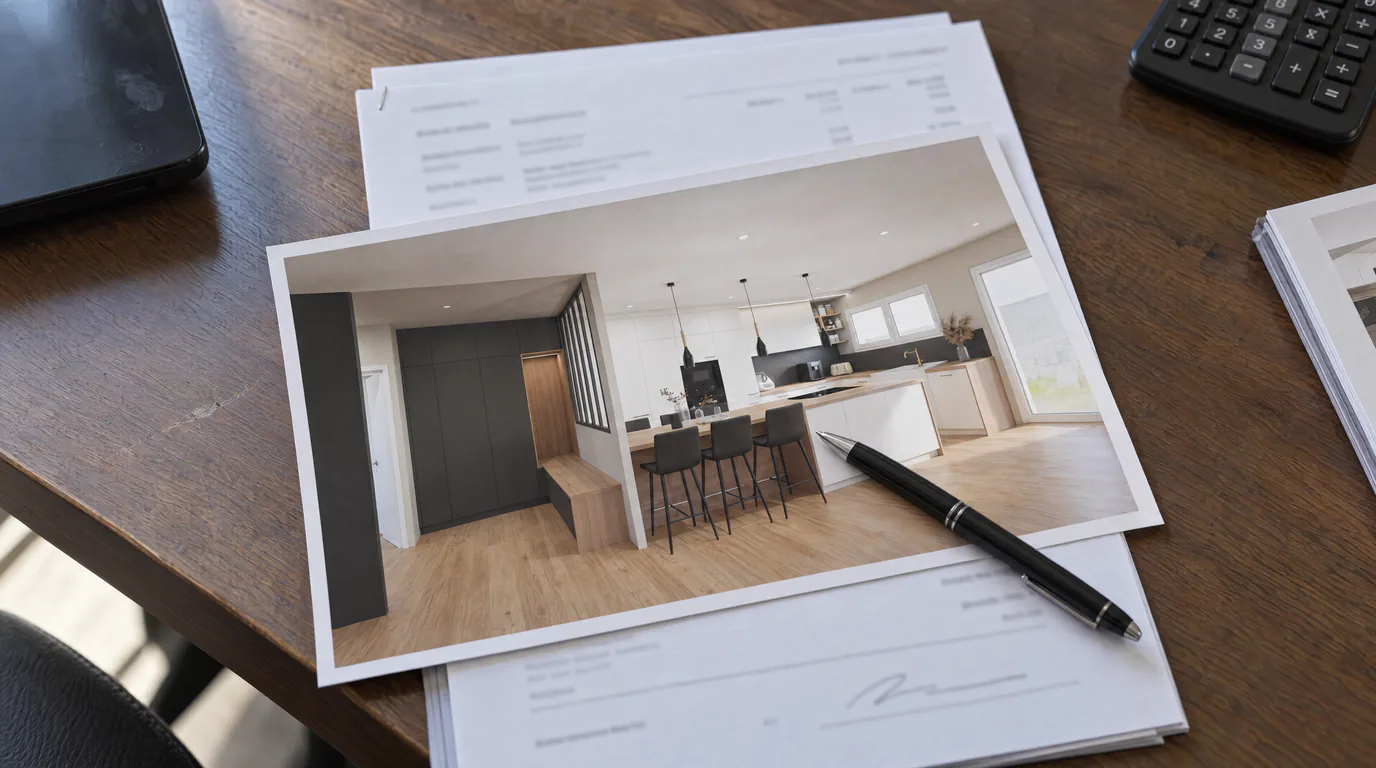
Let us lay out the numbers. The average kitchen project ranges from €8,000 to €15,000. A complete fit-out project (living room, bedroom, home office) often exceeds €20,000. On the investment side, a photorealistic render costs just a few cents, depending on the quality level chosen.
Let us run a worked example, purely for illustration. Imagine you handle 10 prospects per month and your current conversion rate is 30%. That means 3 signed projects. If systematic photorealistic renders lift that rate to 40%, you now sign 4 projects instead of 3.
That additional project, on an average ticket of €10,000, represents €10,000 in additional revenue per month. That is €120,000 per year. For a monthly render investment of a few dozen euros. In this example, the return on investment exceeds 1,000%.
Time is money: the hidden cost calculation nobody makes
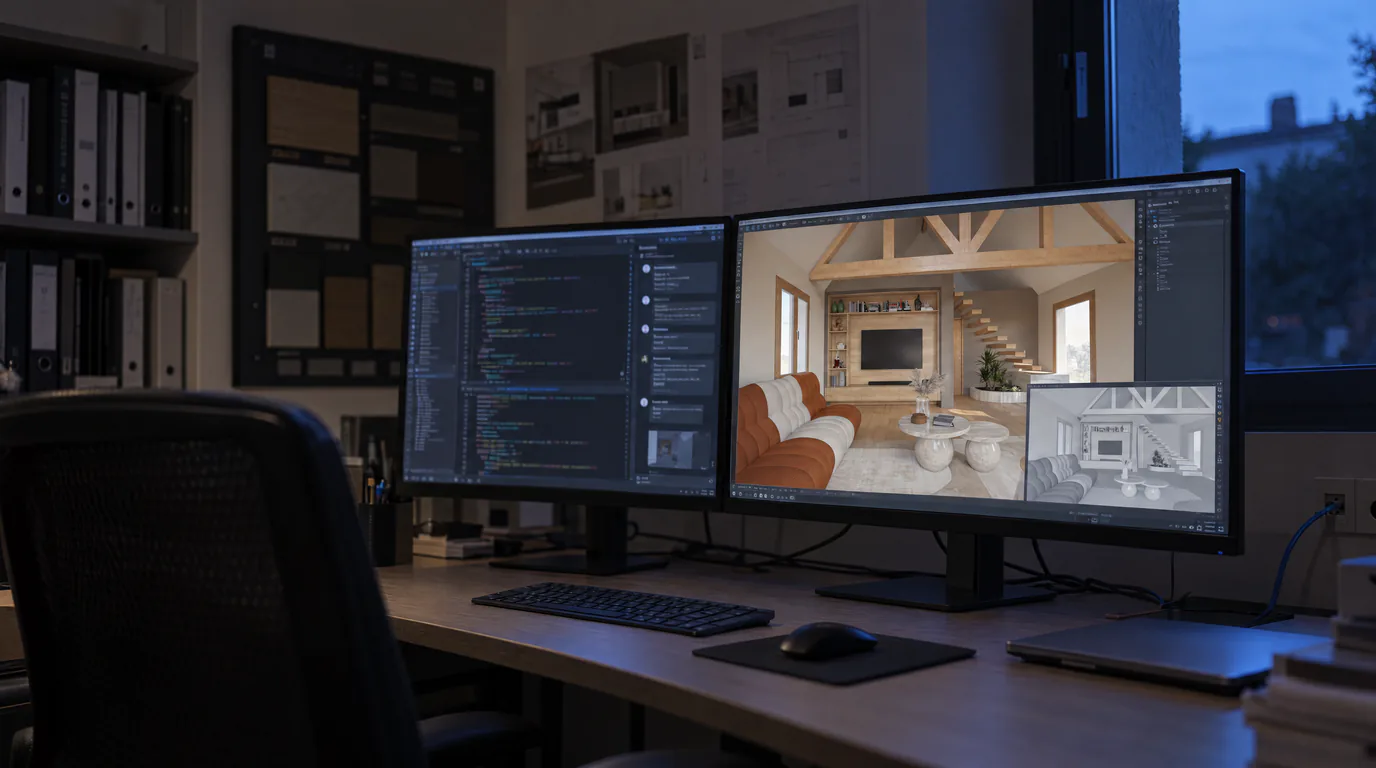
Beyond the conversion rate, there is an even more impactful factor: time. A professional who produces renders with a traditional engine (V-Ray, Lumion, or their design software's built-in renderer) can easily spend around ten hours a week on it, depending on project volume. Material setup, lighting adjustments, render times, tweaks, re-rendering...
With AI rendering, the same work takes approximately 30 minutes per week. Upload, parameter selection, and any material editing. The computation is handled by AI in under 2 minutes per render.
That represents a gain of several hours per week. What do you do with those freed-up hours? You schedule additional client meetings. At a 30% conversion rate, that is potentially 1 extra project per week, or 4 per month. With an average ticket of €10,000, that is €40,000 in potential additional revenue every month.
The compound effect: the virtuous cycle of photorealistic rendering
This example only tells part of the story. There is a compound effect that many overlook.
More renders = more signed projects. When producing a render costs almost nothing in time and money, you produce one for every prospect, not just for "big" projects. That "hesitant" prospect who was not worth 3 hours of V-Ray rendering? With AI rendering, you send them a visual in 10 minutes. And sometimes, that is the project that gets signed.
More signed projects = more referrals. Every satisfied client tells 2 to 3 people in their network. A client impressed by your visuals shares your work on social media. That is free marketing, generated by the quality of your presentations.
More referrals = more qualified prospects. A prospect who comes through a recommendation has a conversion rate 2 to 3 times higher than a cold prospect. The circle reinforces itself.
Break-even analysis for AI rendering
How many renders does it take to recoup your subscription? Let us do the reverse calculation.
If your subscription costs a few dozen euros per month and a single additional project brings in €8,000 to €15,000, it takes just one additional signed project thanks to your renders to cover a full year of subscription.
Even considering only the time savings: if your billable hour is worth €50 (a minimum for an independent professional) and you save around ten hours per week, that is several hundred euros in freed-up time every week. That is well over €2,000 per month in recovered time value, more than enough to cover any subscription plan.
Calculate your own photorealistic rendering ROI
Here is a simple method to estimate your personal return on investment:
Step 1: Your average ticket. What is the average value of your signed projects? Write down that number. For most kitchen designers and interior architects, it falls between €8,000 and €25,000.
Step 2: Your current conversion rate. Out of 10 prospects, how many sign? If you do not measure it exactly, estimate. The industry average is 25 to 35%.
Step 3: Estimated improvement. With systematic photorealistic renders, apply a 30% improvement to your conversion rate. If you were at 30%, you move to 39%.
Step 4: The calculation. Monthly prospects x rate improvement x average ticket = additional revenue. For example: 10 prospects x 9% improvement x €10,000 = €9,000 in additional monthly revenue.
Step 5: The ROI. Divide that figure by your monthly subscription cost. If you pay €49/month and gain €9,000 in additional revenue, your ROI is 183x. Even dividing by 10 to be ultra-conservative, that is still 18x.
Why presentation quality often decides the deal
The quality of visual presentation weighs heavily on a client's decision. Faced with two professionals of comparable skill, the one showing photorealistic visuals immediately inspires more confidence. It is also what we observe among our users: a polished presentation often helps elevate the perceived value of the work and defend a higher rate, for equivalent effort.
This is not surprising. A photorealistic render positions your work as premium. It justifies a higher rate because it demonstrates attention to detail and professionalism that competitors with their 2D plans simply cannot match.
Stop thinking of photorealistic renders as a cost
The most important mindset shift is this: photorealistic renders are not an expense, they are an investment with the highest ROI in your business. No other line item yields as much return for so little input.
Every euro invested in a quality render has the potential to generate hundreds, even thousands of euros in revenue. That is mathematics, not speculation.
Ready to measure the impact on your own business? Try RenderThink free for 14 days and test it with your next project. Compare your signing rate before and after. The numbers will speak for themselves.